The Final Problem 2026 Ending Explained: Who Was the Real Killer in the Mallorca Mystery?
Still with me? Good, because we need to talk.
I’ve watched a lot of locked-room mysteries, and most of them end the same way: the detective gathers everyone in a drawing room, points a finger, and the culprit crumbles. The Final Problem does none of that. It gives you the puzzle, solves it, and then hands you a moral dilemma that bothered me for two days afterward.
The Setup: Thirteen People, One Storm, One Dead Woman
The series adapts Arturo Pérez-Reverte’s novel and drops us into spring 1959. Thirteen people are stranded on the tiny islet of Santa Agueda off Mallorca, cut off by a vicious Mediterranean storm. Then a quiet English tourist, Elisa Mander, is found hanging in a room bolted from the inside, with an overturned chair under her feet.
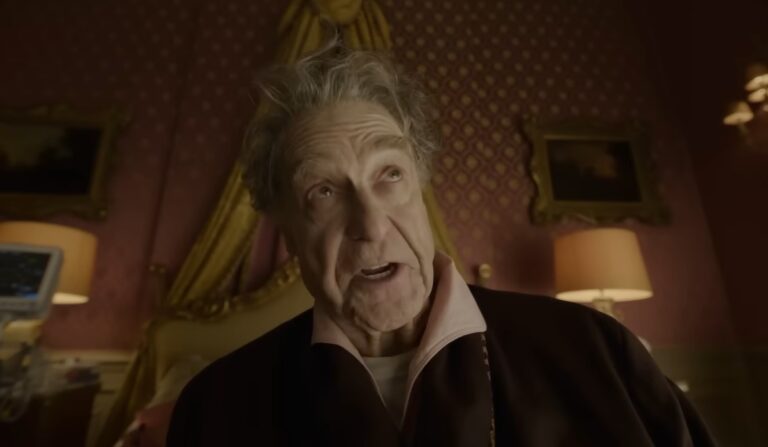
It looks like suicide, and nearly everyone is happy to call it that. With no police and no phone line, the only person who won’t let it go is Basil Benjamin (José Coronado), an aging actor whose entire fame rests on playing Sherlock Holmes on screen.

I love this casting choice. Basil isn’t a detective. He’s a man who has spent decades pretending to be one, memorizing Conan Doyle’s methods without ever using them. Coronado plays him with a tired, wounded dignity, like someone who suspects his whole career has been a costume.
How the Locked Room Actually Works
The scene looks staged to Basil from the start. His theatrical eye catches things a policeman might miss, and he keeps getting stuck on one detail: the missing orange shawl Elisa wore the night she died.
He finds it on his way off the island, half-buried on a secluded beach. That’s the moment the whole thing clicks. Nobody buries a dead woman’s shawl unless it matters.
Here’s how Basil reconstructs the crime:
- The rope: The killer rigged a pulley system on the ceiling beam to hoist the victim, and weakened the rope so it would snap under tension and mimic a self-inflicted drop.
- The chair: It was placed near the door, with the shawl run under the gap at the bottom.
- The lock: Once the door was shut and the latch fell, the killer pulled the shawl from the corridor side. The friction dragged the chair into place and left orange fibers on the lower edge of the door.
- The cleanup: The shawl was the murder weapon, so it had to disappear.
I’ll be honest, the mechanics are the shakiest part of the finale for me. Dragging a chair by a shawl through a door gap takes a lot of faith. But I stopped caring, because the show clearly doesn’t want the trick to be the point. The trick is just the door. What’s behind it is the good part.
The Twist: The Woman Everyone Knew Was Someone Else
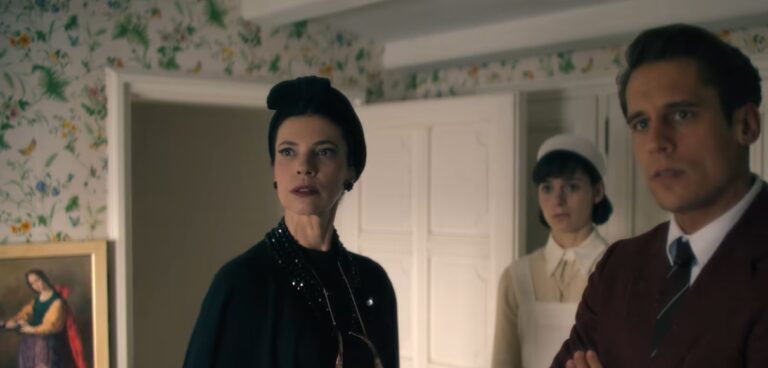
Here’s the reveal that reframes the whole series. The dead woman isn’t Elisa Mander. And the glamorous socialite everyone calls Adela Figueroa (María Valverde) isn’t Adela.
| What everyone believed | The truth |
|---|---|
| The victim is Elisa Mander, a quiet English tourist | The victim is the real Adela Figueroa |
| The survivor is Adela Figueroa, wealthy socialite | The survivor is the real Elisa Mander |
| The death is a suicide | The death is a staged murder |
| Elisa is the “submissive assistant” | Elisa is the mastermind |
The two women looked uncannily alike. For years they played a private, consensual game of swapping clothes, backgrounds, and identities. Adela got to escape the suffocating expectations of high society. Elisa got a taste of wealth, privilege, and luxury she’d never otherwise touch.
Games like that don’t stay innocent, though. Elisa’s amusement curdled into resentment, and the gap between their lives, in money and in futures, started to feel unbearable. At the Mallorca resort she made the swap permanent. She killed Adela, staged the locked-room “suicide,” and dressed the body in her own plain clothes. Then she walked around as Adela, with Adela’s money, papers, credit, and status.
The show also hints that keeping this lie alive required more ruthlessness against anyone who got too close to the truth, and that adds real menace to what could’ve been a sympathetic story.
The Real Target: Hans Klemmer
You’d expect the story to stop at greed. Steal a rich woman’s life, enjoy the champagne, roll credits. Instead the finale reveals the hotel wasn’t a random destination at all.

Elisa came for Hans Klemmer, a former Nazi officer who slipped through the war crimes tribunals, fled Germany through the underground escape networks, and settled into a comfortable, anonymous life among Spain’s elite. Klemmer was responsible for destroying Elisa’s family and for her husband’s agonizing death.
She spent much of her adult life hunting him. When she learned he moved in the same circles as the real Adela, the plan formed. A penniless assistant would never get near his fortified inner circle. A wealthy aristocrat could walk right in.
So the identity theft, the murder, and the elaborate staging were all a means to an end. Adela’s death was a stepping stone toward revenge. That doesn’t excuse it, but it changes the emotional temperature of the entire series.
The Dinner Scene (Yes, the Dinner Scene)
This is where the show earned my respect. There’s no dramatic parlor confrontation with the guests gasping. Basil takes the woman posing as Adela to a quiet, elegant restaurant and lays everything out in a calm, measured monologue that echoes his stage career: the shawl, the pulley, the swap, the hunt for Klemmer.
Her aristocratic composure shatters right there at the table. It’s a small, quiet scene, and I’d argue it’s the best acting in the whole series. Coronado never raises his voice, and he doesn’t need to.
Basil’s Choice: Justice or Mercy?
Now the part that had me pausing the screen. Basil has two options:
- Follow the law. Hand his evidence to the Spanish authorities and let Elisa be tried and punished for the calculated murder of Adela. That’s the textbook Sherlock Holmes ending.
- Follow his conscience. Let her go.
What tips it is Basil’s own guilt. Years earlier, a younger Elisa trusted him when she was at her most vulnerable, and he failed her. He chose his career and his image over a real, flesh-and-blood person. He sees now that his abandonment left her isolated, with very few choices and a road that led straight to hatred and revenge. He doesn’t condone killing, and the show never pretends the murder of Adela was okay. But he doesn’t see a monster. He sees a traumatized survivor of wartime atrocities whom the world’s justice system failed completely.
So he burns the shawl, muddies his findings, and steers the local police toward ruling Adela’s death an undisputed suicide. Elisa walks away with a new name and, maybe, a chance at a quiet life.
The Final Problem Netflix Ending Explained: Killer Identity, Basil’s Choice, and Plot Breakdown
My Take (and Why I’m Still Conflicted)
I went back and forth on this ending for a good while. On one hand, an innocent woman was murdered, and Adela’s only crime was being rich and generous with her friend. Letting her killer walk feels wrong, and I think the show wants it to feel wrong.
On the other hand, the series makes a genuinely bold argument. Basil spent his life playing a man who solved everything with logic, and the finale suggests the smartest thing a person can do is sometimes to not apply the rules. Mercy is a choice, and it costs him the one thing he wanted most: validation as a real detective.
Do I fully agree with him? Not sure. But I respect a mystery that lets me argue with its detective instead of nodding along.
If you’ve finished the series, I’d love to know where you land: was Basil’s mercy an act of grace, or did he just trade one failure for another?